DWDishwashersAEE1
LG dishwasher AE leak error: finding water in the base tray
SymptomThe cycle stops with AE (or E1) on the display and the drain pump runs continuously, even with the door open.
2026.07.16
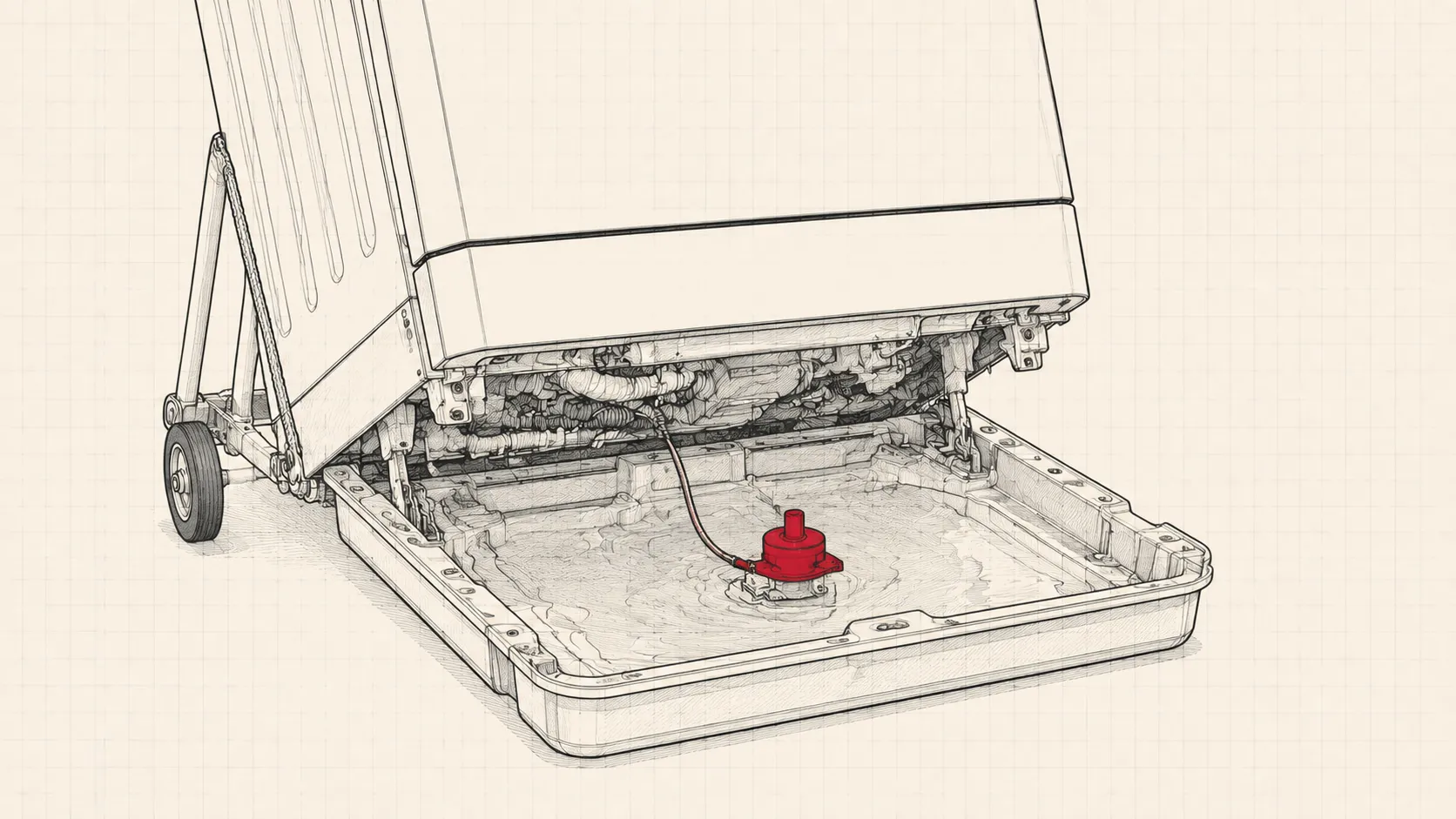
SafetyUnplug the dishwasher and close the water supply before tipping it. Water and a live control board share a cabinet here.
AE is one of the few LG codes that is nearly always literally true. A polystyrene float sits in the base tray under the tub; when water collects there, the float rises, a microswitch closes, and the machine locks out and runs the drain pump to protect the floor.
The pump running non-stop with the door open is the machine doing its job. Resetting it without finding the leak just moves the flood from the tray to the kitchen.
1. Confirm and dry the tray
Pull the machine out, unplug it, close the tap. Put towels down and tip it backwards to about 45°, resting it against something solid.
Water running out from the base confirms the tray is wet. Catch it, then leave the machine tilted for an hour or use a hairdryer on low to dry the tray completely. Some floats stay stuck up on residue even after the water goes.
2. Work the likely sources, easiest first
The door seal
Run a finger round the entire door gasket. Look for a flattened section, a tear, or a piece that has pulled out of its channel. Then look at the bottom corners of the door: that is where a failing seal leaks first, and where you will see limescale streaks on the inside of the door skin.
Close the door on a strip of paper at several points around the perimeter. It should grip everywhere. Somewhere it slides out freely is where water is getting past.
The spray-arm bearing
Check the centre of the lower spray arm where it sits on its post. If the arm wobbles noticeably or the retaining nut has loosened, water sprays sideways at pressure onto the door and past the seal rather than up onto the dishes.
The sump and filter seat
Lift out the filter stack. Under it the sump gasket seals the wash pump to the tub floor. Look for scale trails or a white crust radiating from the joint: that is the signature of a slow seep.
The inlet hose and its coupling
Follow the supply hose from the tap to the machine, feeling for damp. LG uses an aquastop coupling on many models; if the hose has ever been over-tightened, the collar cracks and weeps under pressure only.
Where AE leaks originate, by frequency
- Door seal / lower corners
- Most common
- Sump or heater gasket
- Common on older machines
- Spray-arm bearing or loose nut
- Occasional
- Inlet hose coupling
- Occasional
- Tub seam corrosion
- Rare: usually end of life
3. Rule out the imposter: too much foam
If nothing is wet and the tray was only lightly damp, suspect detergent. Washing-up liquid in a dishwasher (or a rinse-aid dispenser set far too high) creates foam that overflows the tub through the door and drips into the base.
The tell is a fine soap film on the inside of the door and around the vent. Run a full hot cycle empty with no detergent at all, then use only dishwasher tablets afterwards.
4. Test before you push it back
With the tray dry and the suspected part fixed, stand the machine up, reconnect the water, and run a short cycle with the machine still pulled out and a torch pointed underneath. Watch it fill, watch the first wash phase, and look for a drip. Five minutes of watching here saves pulling the machine out twice.
5. When the float switch itself has failed
Rarely, the tray is bone dry and AE persists on a clean machine. The float can jam upward on a fragment of packing foam, or the microswitch under it can fail closed.
The float is visible from underneath as a small polystyrene block in a plastic cage. It should drop freely and rattle when you shake it. If it moves properly and the code still stands, the switch or its harness is the fault, and at that point you are into board-level testing with a multimeter.
Preventing the next one
Wipe the door gasket every few weeks, especially the bottom corners where debris collects and slowly deforms the rubber. Do not overload the lower basket in a way that stops the spray arm rotating freely: an arm that catches on a baking tray puts side load on its bearing until it leaks. And never use hand dish soap, not even once.