WMWashing machinesIE
LG washing machine IE error: why the tub will not fill
SymptomThe cycle starts, the drum turns briefly, then everything stops and IE (or 1E) appears. No water, or a trickle that never fills.
2026.06.30
SafetyClose both taps before disconnecting any hose. Household mains water is at full pressure behind that coupling.
IE is the mirror image of OE. The board opens the inlet valve, watches the pressure sensor, and expects the target level within about eight minutes. If the level never arrives (or arrives too slowly), the fill is abandoned and IE goes up on the display.
The important consequence: IE does not mean “no water”. It means “not enough water, fast enough.” A tap that is only a quarter open produces IE just as reliably as a tap that is fully closed, and it is much easier to overlook.
1. Both taps, fully open
Cold-fill-only machines have one hose. Hot-and-cold machines have two, and a machine plumbed for both will throw IE if either tap is shut, even on a cold wash, because the board still tests both circuits.
Open each tap fully, not part way. Quarter-turn lever valves are either open or closed; screw-type taps need winding all the way back.
2. Clean the inlet screens
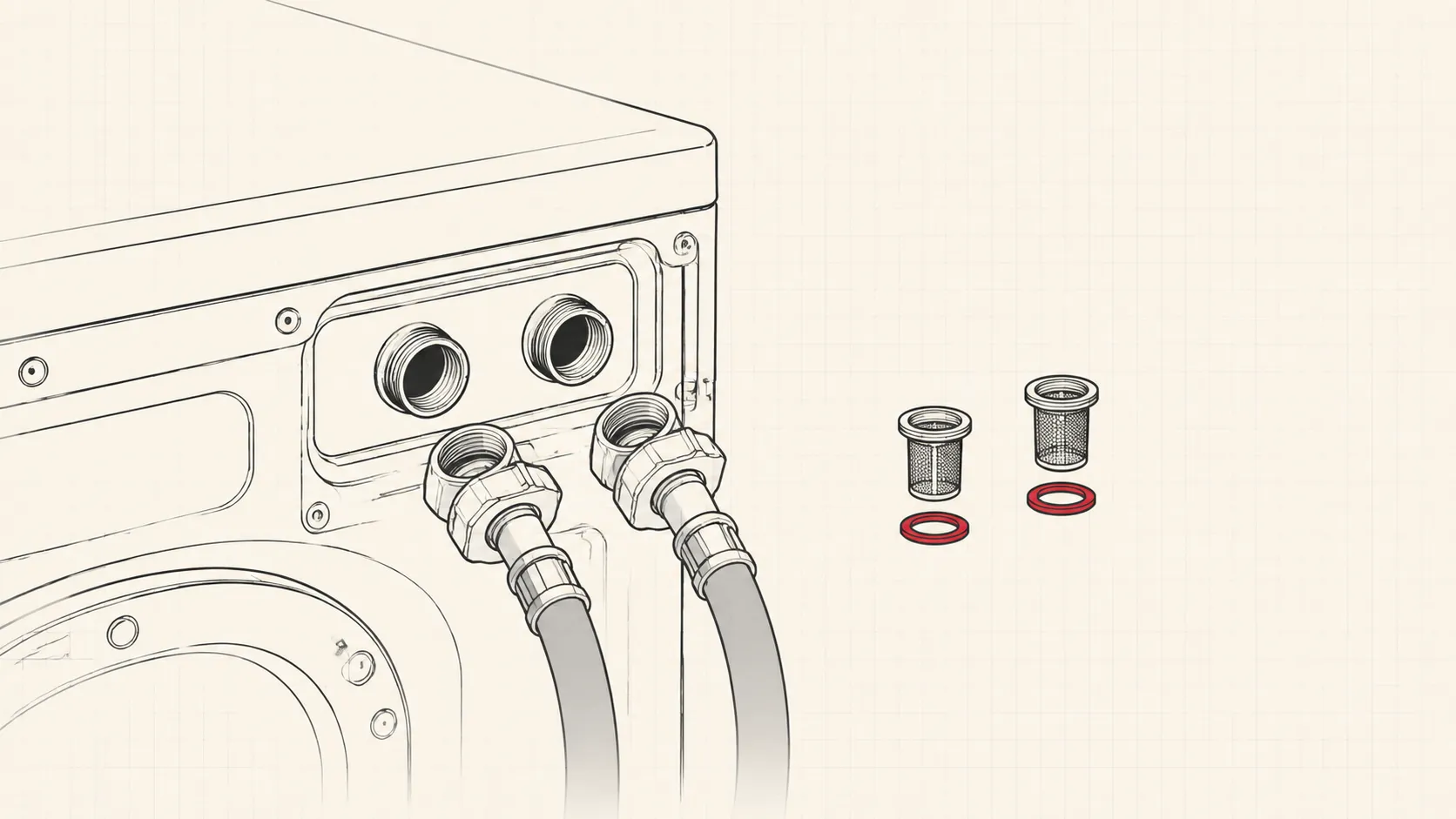
Every LG inlet hose has a fine mesh screen. There is one at the tap end and one inside the coupling at the machine end, and they exist to keep grit out of the solenoid valve. Over a few years they silt up with rust flakes and scale.
With the taps closed:
- Unscrew the hose from the machine. Have a towel ready: there is always a cupful left in the hose.
- Look into the machine’s inlet port. The screen is a small plastic-rimmed mesh disc, often already brown.
- Ease it out with long-nose pliers, gripping the plastic rim rather than the mesh.
- Scrub both faces under a running tap with an old toothbrush. If the mesh is torn or the rim is cracked, replace it: they cost very little.
- Push it back in squarely, and repeat at the tap end.
Hand-tighten the couplings, then a quarter turn with the spanner. These are rubber-sealed; over-tightening splits the collar.
Fill circuit reference
- Expected supply pressure
- 0.5 – 8 bar
- Typical fill window before IE
- ≈ 8 min
- Inlet valve coil resistance
- ≈ 3.5 – 4.5 kΩ
- Screen cleaning interval
- Every 2 years
3. Straighten the hose
Check the whole run behind the machine for kinks and crush points, exactly as you would for a drain fault. Inlet hoses are stiffer than drain hoses, so instead of folding flat they tend to develop a tight radius right at the machine coupling, enough to halve the flow without looking dramatic.
While you are back there, confirm the hose is not looped over the top of the machine or trapped under a foot.
4. Listen to the valve
Reconnect everything, open the taps, and start a rinse cycle with the door closed. Put your ear near the back-left of the machine.
- A soft click then a rush of water: the valve is working; your problem was upstream and is now fixed.
- A click but no water: the valve is opening electrically but is blocked or seized internally. Replace the valve assembly.
- Silence: the valve is not being energised. That is either the harness or the control board, and the next test needs a multimeter across the coil.
5. The confusing one: fills, then IE anyway
If the drum visibly fills and IE still appears, the machine is filling but cannot measure it. That is a pressure-sensing fault, not an inlet fault: the same clear sensing tube described in the drain-error procedure. Blow through it and check it rises continuously to the sensor.
A machine that fills and keeps filling until water reaches the door glass has a valve stuck open, which usually shows as FE rather than IE. Close the taps immediately and replace the valve.
Keeping it away
Clean the inlet screens every couple of years: sooner in hard-water areas or on old iron pipework. If your machine sits behind a plumbing job that has just been done, expect one IE within a fortnight: disturbed pipework sheds scale, and the screens are the first thing it meets.