WMWashing machinesUEuE
LG washing machine UE: unbalanced load, or something worse
SymptomThe machine fills and refills at the end of the cycle, tries repeatedly to spin, then gives up with UE and clothes that are still soaking.
2026.07.02
SafetyNever reach into a drum that is still turning. After a failed spin the drum can free-wheel for a surprisingly long time.
Before a spin, the machine ramps the drum to distribution speed and watches how hard the motor has to work through each revolution. An even load draws even current. A load bunched on one side draws a current spike once per rotation, and the control refuses to accelerate, because a 1,400 rpm spin with a lopsided drum can walk a machine across a room.
So the first question is not “how do I clear UE” but “how often does it happen?”
The triage question
- Occasionally, on specific loads: a laundry problem. Sections 1 and 2 below.
- On most loads, whatever they are: an installation problem. Section 3.
- Every cycle, including an empty drum: a mechanical problem. Section 4.
1. The loads that cause it
Three patterns are responsible for nearly all genuine imbalance:
- One heavy item alone. A single bath mat, a mattress protector, a winter coat. It absorbs water, becomes a slab of dead weight, and cannot spread out. Add two or three towels to give it something to balance against.
- Bedding that wraps. A duvet cover behaves like a bag: smaller items climb inside it during the wash and end up as one lump at one side. Fasten the buttons or zip before washing.
- A near-empty machine. Two items in a 9 kg drum have nothing to distribute against. Counter-intuitively, adding laundry fixes this.
Open the door, pull everything apart by hand, spread it evenly around the drum, and restart on a spin-only cycle.
2. Detergent overdose (yes, really)
Excess detergent produces a foam cushion that lets the load slide rather than grip the drum ribs. The machine sees a load that will not settle and calls it unbalanced.
If you have recently switched to a concentrate, or you dose by eye, halve it for three cycles and see whether UE disappears. Then run a Tub Clean cycle to clear the residue already in the system.
3. Levelling: the fix people skip
A front-loader must sit on all four feet with no rock at all. Not “nearly”: any movement lets the drum’s own oscillation feed back into the cabinet.
Levelling reference
- Maximum acceptable rock
- None: zero movement
- Level tolerance
- ≤ 1° in both axes
- Foot lock nuts
- Tight against the cabinet
- Floor
- Solid; never on a rug or loose vinyl
- Push down hard on each corner in turn. Any rock at all means a foot is short.
- Wind the short foot down until the rock stops.
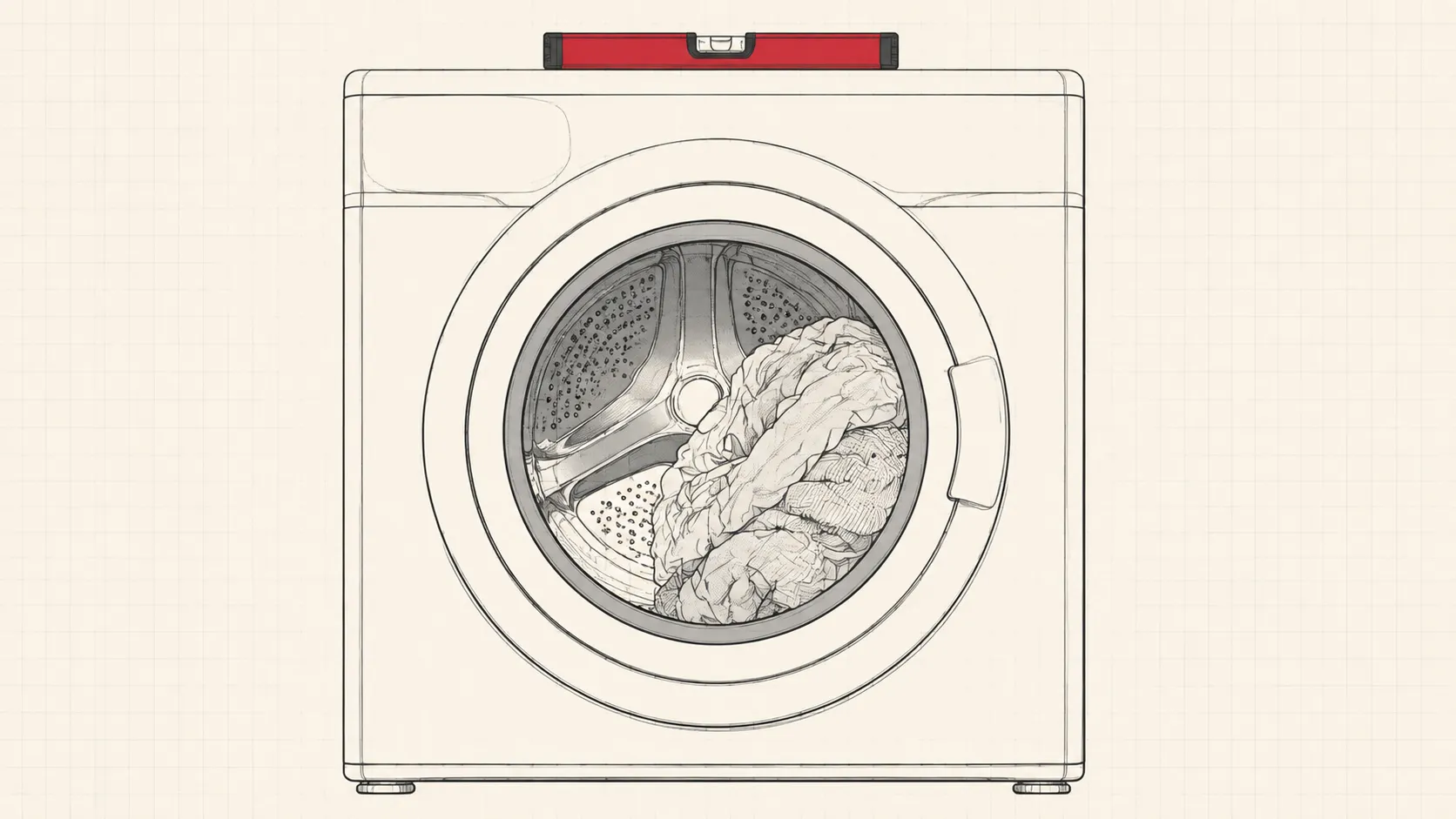
- Put a spirit level across the top, front to back and side to side, and correct with the front feet.
- Tighten the lock nuts. Every foot has one, they arrive from the factory loose, and a foot that can wander undoes your work in a fortnight.
On timber floors, a machine that is perfectly level can still resonate. A 20 mm plywood sheet under it spreads the load and often removes the problem completely.
4. When it is the suspension
If an empty drum on a spin-only cycle produces UE, the fault is inside the machine.
Open the door and pull the drum sharply downward, then let go. A healthy machine returns and settles in one movement. If it bounces two or three times before settling, the shock absorbers have lost their damping.
Then rock the drum front-to-back and side-to-side by hand. Play at the back with a rumbling or grating feel points at the drum bearings, and that is a different, much larger job: on most LG front-loaders the bearing sits in a sealed outer tub, so the practical repair is a tub assembly rather than a bearing.
Ruling out the electronics
Before condemning anything mechanical, remember that UE can also come from a rotor-position sensor that is losing count: the same Hall sensor behind LE and SE. If the drum is mechanically tight, the machine is level, and UE still appears on an empty spin, check the three-wire Hall connector on the stator for corrosion before ordering suspension parts.