RFRefrigeratorsEr dHEr FFEr dSOF F
LG refrigerator not cooling: defrost, fans, and the demo-mode trap
SymptomThe freezer still makes ice but the fresh-food compartment sits at room temperature, or both compartments drift warm while the compressor keeps running.
2026.07.21
SafetyUnplug the refrigerator before removing the rear freezer panel. Never chip ice off an evaporator with a screwdriver, puncturing an aluminium coil ends the appliance.
Almost every “LG fridge not cooling” call is one of four things, and they can be separated in about ten minutes before any panel comes off.
0. Demo mode: check this first, always
If the lights work, the display responds, the fans are silent and nothing gets cold, the appliance may simply be in showroom mode. It exists so retailers can light a fridge without running the compressor, and it survives being unplugged, delivered and installed.
The display shows OF F (with a gap) on many models, or nothing unusual at all on others.
To exit, hold Ice Plus (or Refrigerator) and Freezer together for about five seconds until the unit chimes. If your panel differs, the model manual lists the pair: it is always two buttons held together.
1. Which compartment is failing?
Freezer cold, fridge warm is the classic pattern and it is nearly always airflow. On these models the fridge does not have its own evaporator, cold air is blown from the freezer evaporator through a duct. If that duct or the fan behind it stops, the freezer stays cold and the fridge starves.
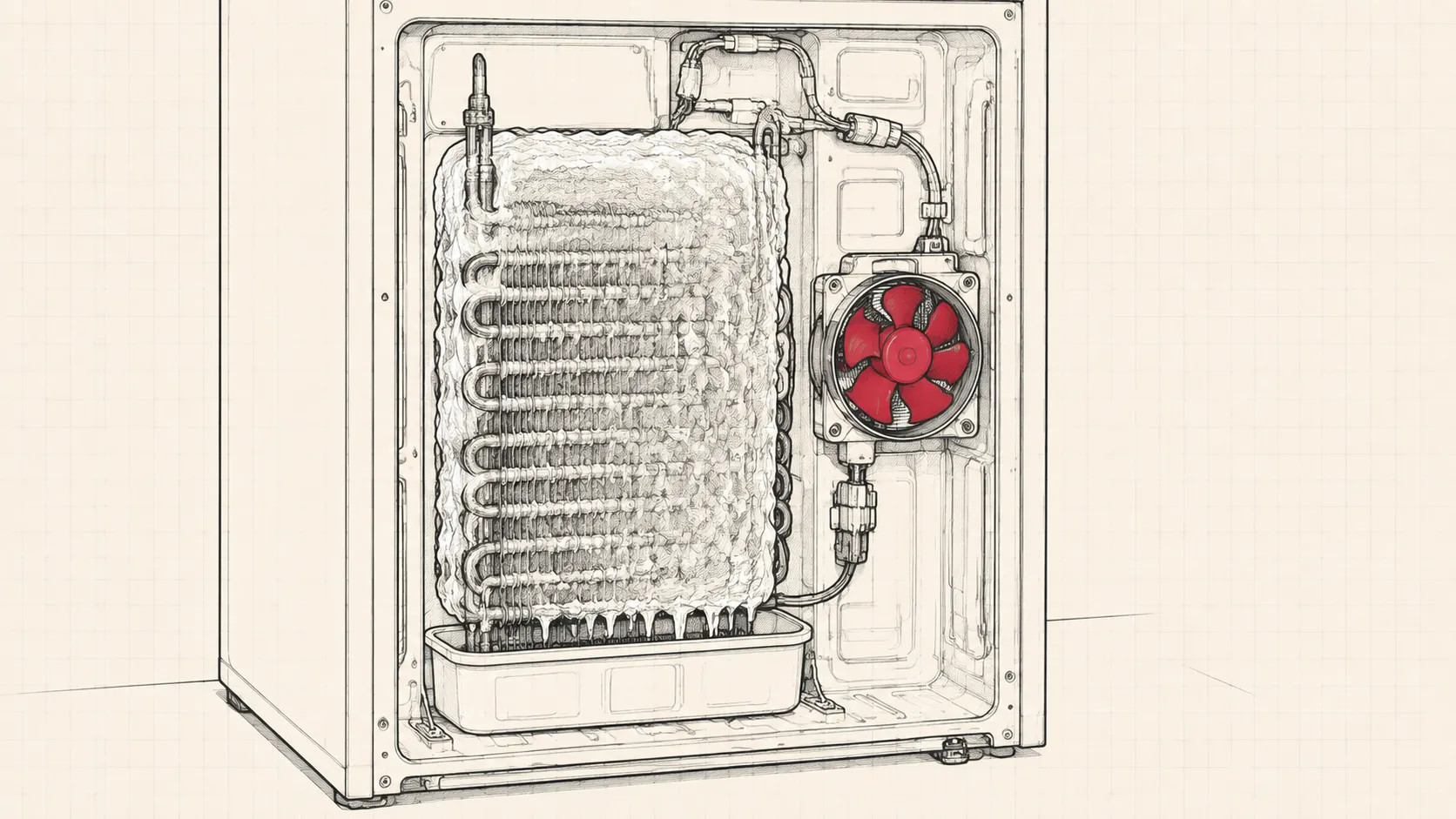
Both warm, compressor running constantly points at defrost failure: the evaporator has iced into a solid block and air can no longer pass through it.
Both warm, compressor silent is a different investigation, start at the compressor relay and the mains supply.
2. Listen for the evaporator fan
Open the freezer and hold the door switch in with a finger, or press it and hold. Within a few seconds you should hear a fan behind the rear panel.
- Fan running, no cold air at the fridge vents: the duct between compartments is iced up. Go to defrost.
- Fan silent: either it is iced and jammed, or the motor has failed. Er FF confirms it electrically.
- Fan ticking or grinding: ice is catching the blade. Defrost first, then re-test before condemning the motor.
3. Look at the evaporator
Unplug the appliance. Empty the freezer, remove the shelves and the icemaker if it is in the way, and take out the rear panel, typically four to six Phillips screws plus a few clips.
What you should see: a clean aluminium fin coil with a light, even frost.
What you will probably see: a solid white block filling the fin pack completely.
4. Force a full defrost
Leave the appliance unplugged with the doors open and towels down, for at least eight hours: overnight is safer. Rushing this is the single most common reason a repair “does not work”: a coil that looks clear at the front can still be solid behind the fins.
When it is genuinely clear, plug in and watch. If it cools normally for a day or two and then fails again in exactly the same way, you have confirmed the defrost system is not working: the manual defrost only bought time.
5. Find which defrost part failed
Defrost circuit checks (unplugged)
- Defrost heater resistance
- Continuity present: open = failed
- Thermal fuse / bi-metal
- Continuity when cold
- Defrost sensor (thermistor)
- Reads plausible resistance, not open/short
- Common failure
- Thermal fuse open after a heater fault
The heater is a glass or sheathed tube clipped along the bottom of the evaporator. The thermal fuse is a small capsule clipped near the top. Both are checked for continuity with the appliance unplugged and the connector unplugged.
An open thermal fuse and a healthy heater means the fuse did its job during an earlier overheat, replace both, because a fuse rarely opens without a reason.
An open heater is the part. A heater and fuse that both test fine, with a coil that still ices, points at the defrost sensor or the control board, and that is where a home repair reasonably stops.
6. If the fan is the fault
With the ice gone, spin the fan blade by hand. It should turn freely. Then plug in and hold the door switch: no rotation with a free blade means the motor or its harness.
Evaporator fan motors are a straightforward swap, usually two screws and one connector once the panel is off. Check the harness for chafe where it passes the panel edge before fitting the new one.
What this is not
It is almost never a refrigerant leak. Sealed-system faults exist, but they present differently: continuous running with a warm condenser, no frost at all on the evaporator rather than too much, and no error codes. Sealed-system work is licensed trade in most countries and is not a home repair.
Keeping it cooling
Vacuum the condenser coil twice a year: underneath or at the rear, depending on model. Leave a finger’s gap between the rear of the cabinet and the wall. Do not block the fresh-food vents with tall containers. And when a door has been left ajar overnight, expect one heavy frost event: that moisture has to come off the evaporator before normal cooling resumes.